An Overview of GNU Radio
GNU Radio is a free and open-source software development toolkit providing real-time signal processing blocks to implement software-defined radios and simulate wireless communication systems. Combined with external RF hardware, it forms a complete Software-Defined Radio (SDR) platform.
1. Introduction & Historical Milestones
GNU Radio is widely adopted across academic institutions, government research laboratories, and commercial telecommunications companies to prototype physical-layer protocols for 2G, 3G, 4G, 5G NR, 6G research, satellite, and radar systems.
- 2001 (Inception): Founded by philanthropist John Gilmore and lead architect Eric Blossom to build an open-source digital signal processing engine.
- 2009 (GNU Radio Companion): Release of GRC 3.2 authored by Josh Blum, introducing an intuitive drag-and-drop graphical flowgraph editor.
- 2011 (GRCon Conference): Establishment of the annual GNU Radio Conference (GRCon), bringing together open-source radio developers worldwide.
- 2020s–Present (GNU Radio 3.9+ / 3.10+): Modernized runtime architecture featuring Pybind11 (replacing SWIG for lightweight C++/Python bindings), VOLK 3.x SIMD acceleration, native C++17/20 support, modular custom OOT development, and integration with AI/ML frameworks.
2. Software Architecture & Modern Pybind11 Integration
To deliver maximum computational performance under high sampling rates, GNU Radio’s core runtime environment and signal processing algorithms are written entirely in C++.
In modern GNU Radio releases (3.9+ and 3.10+), Pybind11 replaced legacy SWIG bindings. Pybind11 creates lightweight C++11/17 headers that seamlessly expose C++ DSP classes to Python with minimal overhead. This architecture enables developers to construct complex flowgraphs using Python scripts while executing performance-critical DSP loops in native C++ machine code.
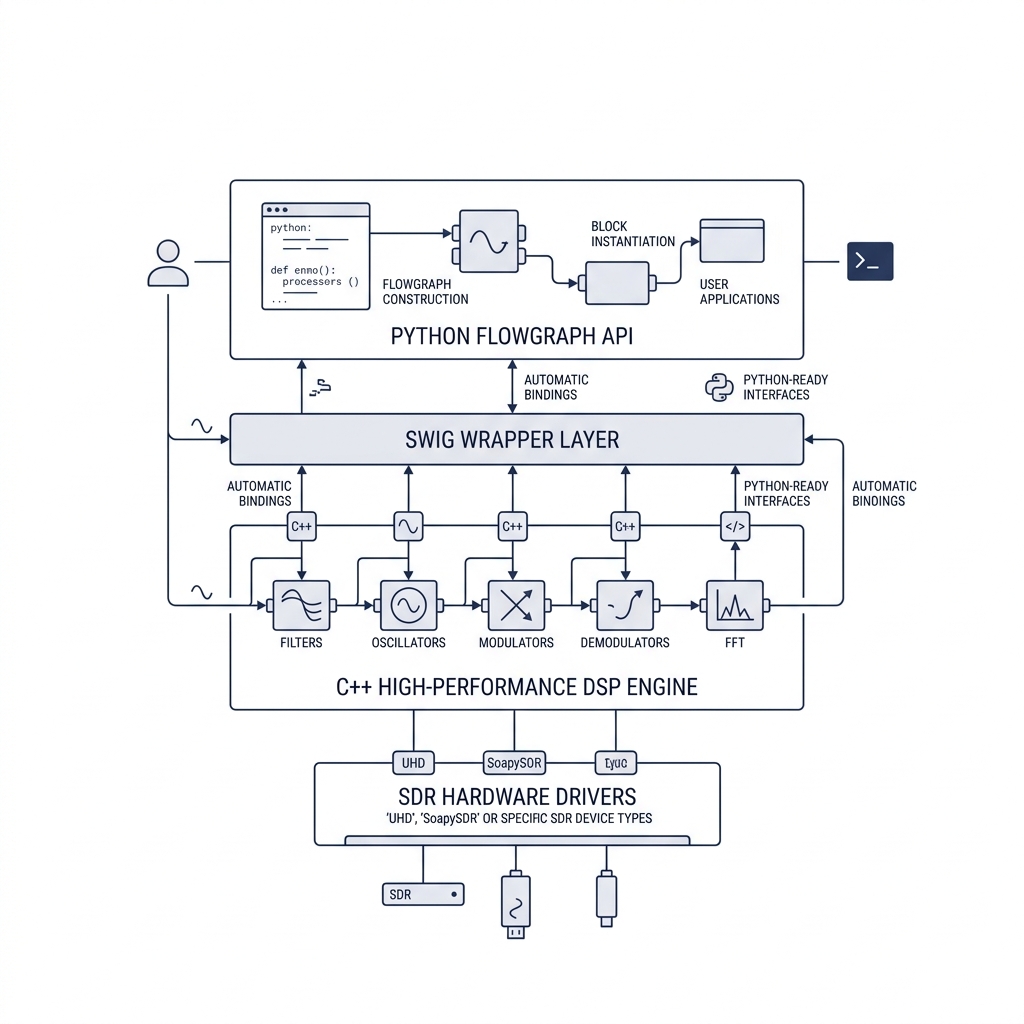 Figure 1. Architectural framework of GNU Radio showing C++ DSP core engine, Python bindings (Pybind11), block library, and hardware drivers.
3. GNU Radio Companion (GRC) Visual Interface
For visual development, GNU Radio Companion (GRC) provides a canvas-based graphical user interface:
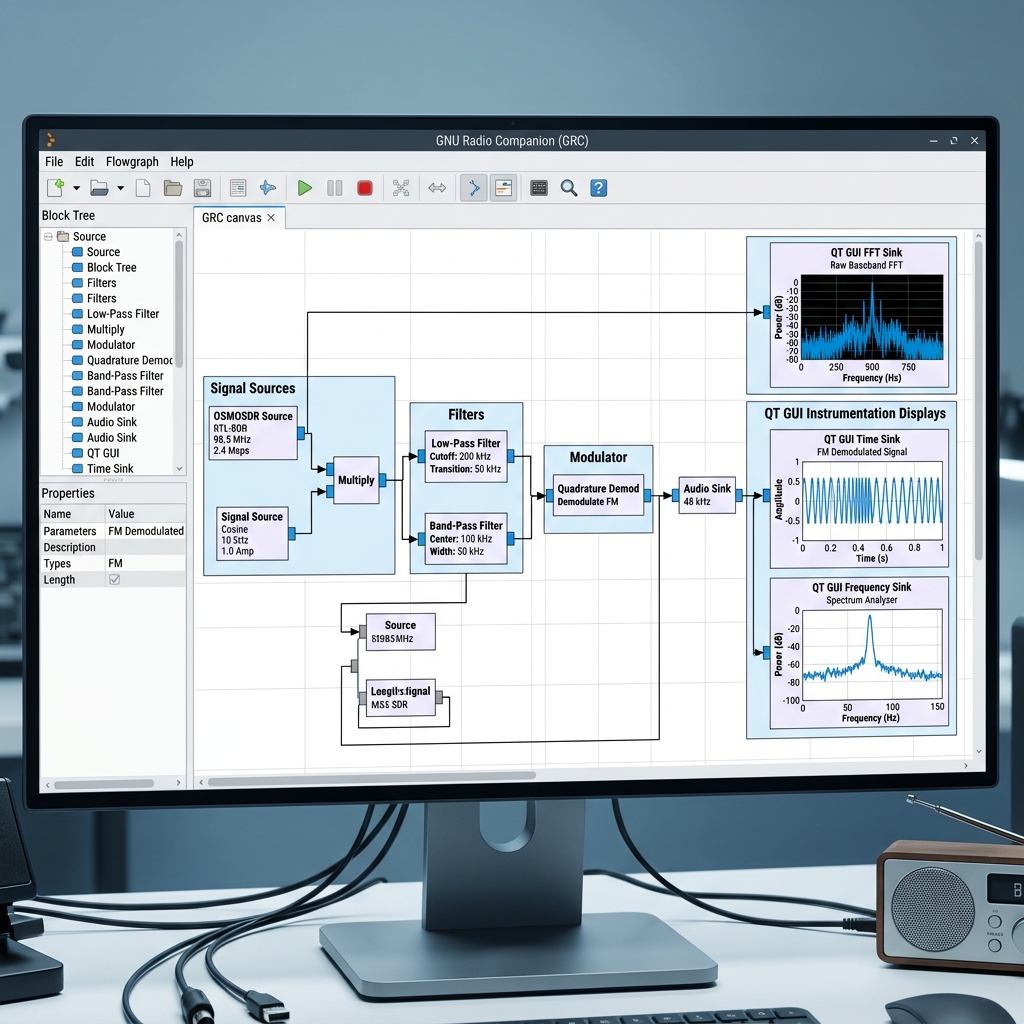 Figure 2. GNU Radio Companion (GRC) flowgraph editor displaying connected signal processing blocks and real-time QT GUI sinks.
In GRC, developers build applications by connecting Sources (e.g., SDR receivers, signal generators), Processing Blocks (filters, modulators, equalizers), and Sinks (SDR transmitters, audio output, file storage, QT GUI instrumentation plots).
When executed, GRC compiles the flowgraph topology into a standalone Python or C++ application that invokes the underlying C++ execution engine.
4. Built-in Signal Processing Block Library
GNU Radio ships with a comprehensive library of production-ready processing blocks categorized into core DSP functions:
+-----------------------------------------------------------------------------------+
|  [Waveform Generators]  -->  [Modulators / Demodulators]  -->  [Channel Models]   |
|                                                                                   |
|  [Fourier & Spectral]   <--  [Digital Filters (FIR/IIR)]   <--  [GUI Sinks/WFE]    |
+-----------------------------------------------------------------------------------+
Signal Sources & Generators
- Signal Source: Cosine, Sine, Square, Sawtooth, and Triangle wave generators.
- Noise Source: Gaussian, Uniform, and Fast Noise generators.
- Constant Source: Fixed DC and vector data streams.
Modulators & Demodulators
- Analog Schemes: AM Demodulator, Quadrature Demodulator, WBFM/NBFM Transceivers.
- Digital Schemes: BPSK/QPSK/8PSK Mod/Demod, QAM Mod/Demod, GFSK, Continuous Phase Modulation (CPM).
- Multi-Carrier & Spread Spectrum: OFDM Transceiver blocks, Frame Synchronizers, Channel Estimators.
Channel Models & Impairments
- AWGN Channel Model: Configurable noise voltage, frequency offset, and timing drift.
- Fading Models: Rayleigh Fading, Rician Fading, and Frequency-Selective Multipath Fading.
Digital Filtering & Spectral Analysis
- Filters: Low-Pass, High-Pass, Band-Pass, Band-Reject, Decimating FIR, IIR Filters, Hilbert Transform, Root Raised Cosine (RRC).
- Spectral Tools: Fast Fourier Transform (FFT), FLL Band-Edge, Rational Resampler, PN Correlator.
5. Extending GNU Radio: Custom Out-Of-Tree (OOT) Modules
When research requires custom algorithms beyond built-in blocks, GNU Radio allows developers to write custom Out-Of-Tree (OOT) modules in C++ or Python:
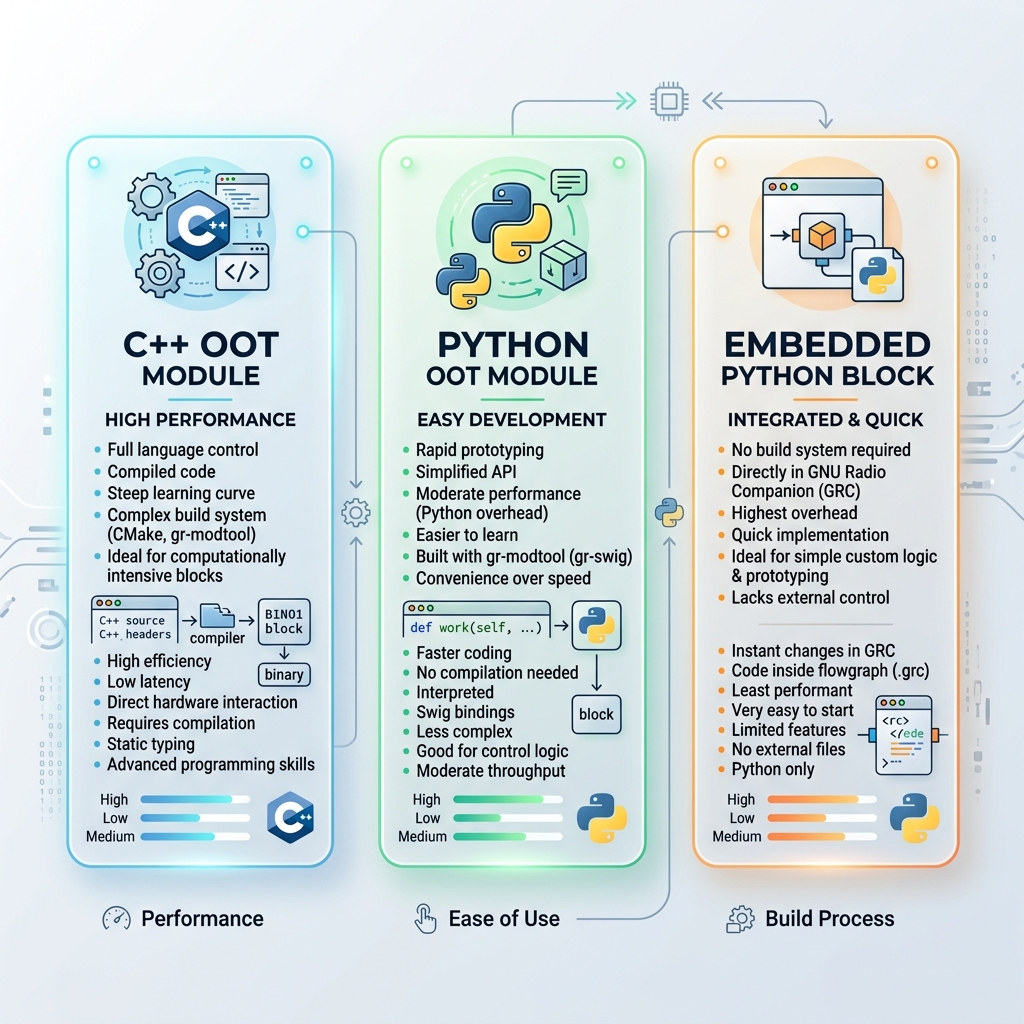 Figure 3. Detailed technical comparison of custom block implementation methods in GNU Radio.
| Feature / Metric | C++ OOT Module | Python OOT Module | Embedded Python Block |
|---|---|---|---|
| Execution Performance | Maximum (Native Compiled C++) | Moderate (Python Overhead) | Moderate |
| SIMD Acceleration | Full VOLK Support | Limited | No |
| Development Effort | Higher (C++ & Pybind11 setup) | Moderate | Lowest (Inline GRC edit) |
| Best Used For | High-rate computational DSP | Protocol control logic | Quick prototyping & testing |
6. Real-World Applications & Portfolio Projects
In our research lab, custom Out-Of-Tree (OOT) modules have been built for over-the-air testbeds:
-
gr-ofdm_testbed: Real-time OFDM transceiver OOT module implementing frame preamble synchronization, channel estimation, and payload streaming on BladeRF hardware. -
gr-DoA_BladeRF: Multi-SDR array processing system implementing MUSIC Direction of Arrival (DoA) and hardware clock synchronization across independent BladeRF units. -
SDR_NC: Physical-layer network coding testbed for cognitive wireless networks and multi-robot communications. - Official Documentation: Explore the official wiki and tutorials at https://wiki.gnuradio.org/.
Explore our detailed project page on Software-Defined Radio (SDR) & GNU Radio Projects to see our custom OOT modules and hardware testbeds in action.
Enjoy Reading This Article?
Here are some more articles you might like to read next: