An Overview of Software-Defined Radio (SDR)
Software-Defined Radio (SDR) is a wireless communication paradigm where traditional physical-layer hardware components (such as mixers, filters, amplifiers, modulators, and demodulators) are implemented primarily through software executing on general-purpose computers, embedded systems, or hardware accelerators.
1. Fundamental System Architecture
A standard Software-Defined Radio system consists of a host computer equipped with high-speed Analog-to-Digital Converters (ADC) and Digital-to-Analog Converters (DAC), connected to a flexible Radio Frequency (RF) front-end for signal transmission and reception.
Unlike traditional fixed-function hardware radios that rely on dedicated analog circuits or Application-Specific Integrated Circuits (ASICs), an SDR delegates signal processing tasks to a General-Purpose Processor (GPP), a Graphics Processing Unit (GPU), or an onboard Field-Programmable Gate Array (FPGA). Consequently, a single hardware transceiver can dynamically adapt its operating frequency, bandwidth, modulation scheme, and protocol stack purely through software reconfiguration.
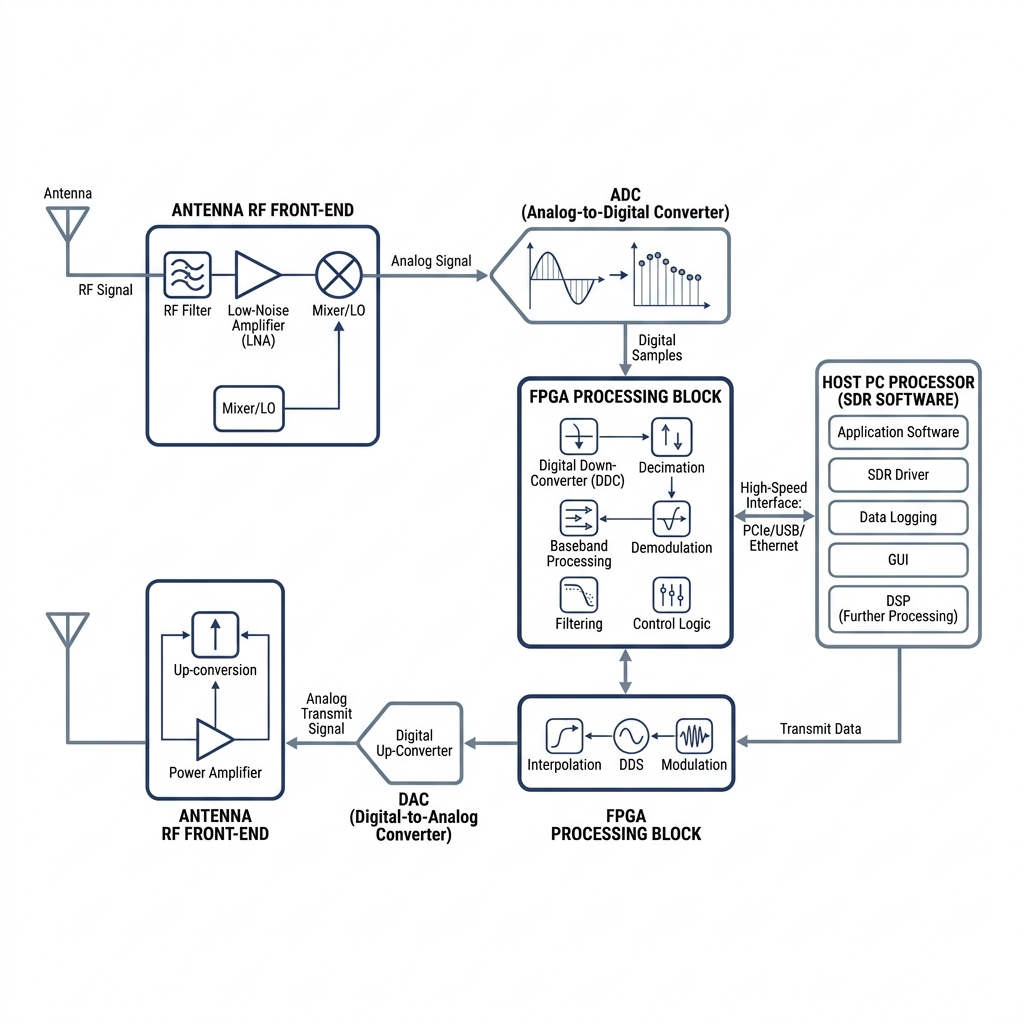 Figure 1. Architectural blueprint of a Software-Defined Radio transceiver system showing RF front-end, high-speed converters, FPGA baseband, and GPP host processor.
2. Historical Context & Technical Milestones
The trajectory of SDR technology spans several major military, industrial, and academic developments over the past five decades:
- 1970s (Digital Receiver): The concept emerged under U.S. Department of Defense research as digital signal processing hardware started replacing analog discriminator circuits.
- 1990–1995 (SpeakEasy Project): Developed for the U.S. Air Force to build a tactical ground-to-air radio capable of operating across a wide spectrum from 2 MHz to 2 GHz using programmable waveforms.
- 1991 (Software GSM Base Station): Joe Mitola constructed an early software-based GSM base station prototype, laying the groundwork for software-defined cellular infrastructure.
- 1995–1996 (Formalization): The term Software-Defined Radio was formally coined by Stephen Blust and presented at the Modular Multifunction Information Transfer Systems (MMITS) forum in 1996.
- 2000s–2010s (Open Source & Mass Hardware Adoption): Emergence of accessible platforms (USRP, bladeRF, HackRF, RTL-SDR) alongside mature open-source DSP frameworks (GNU Radio, srsRAN, OpenAirInterface).
- 2020s–Present (5G-Advanced, 6G Near-Field & AI-Driven SDR): SDR has become the fundamental foundation for 5G/6G physical-layer prototyping, incorporating Extremely Large-Scale Antenna Arrays (ELAA), near-field channel estimation, multi-SDR array synchronization, and deep learning-assisted baseband processing.
+-----------------------------------------------------------------------------------------+
| 1970: Digital Receiver  -->  1990: SpeakEasy Project    -->  1991: Software GSM BS      |
|                                                                                         |
| 1995: "SDR" Coined      -->  2000s: JTRS, USRP & GRC   -->  2020s+: 5G/6G, AI & ELAAs  |
+-----------------------------------------------------------------------------------------+
3. Commercial Hardware Spectrum: Entry-Level to Research Grade
SDR hardware spans a wide spectrum of performance capabilities, bandwidths, and cost tiers tailored to different application domains:
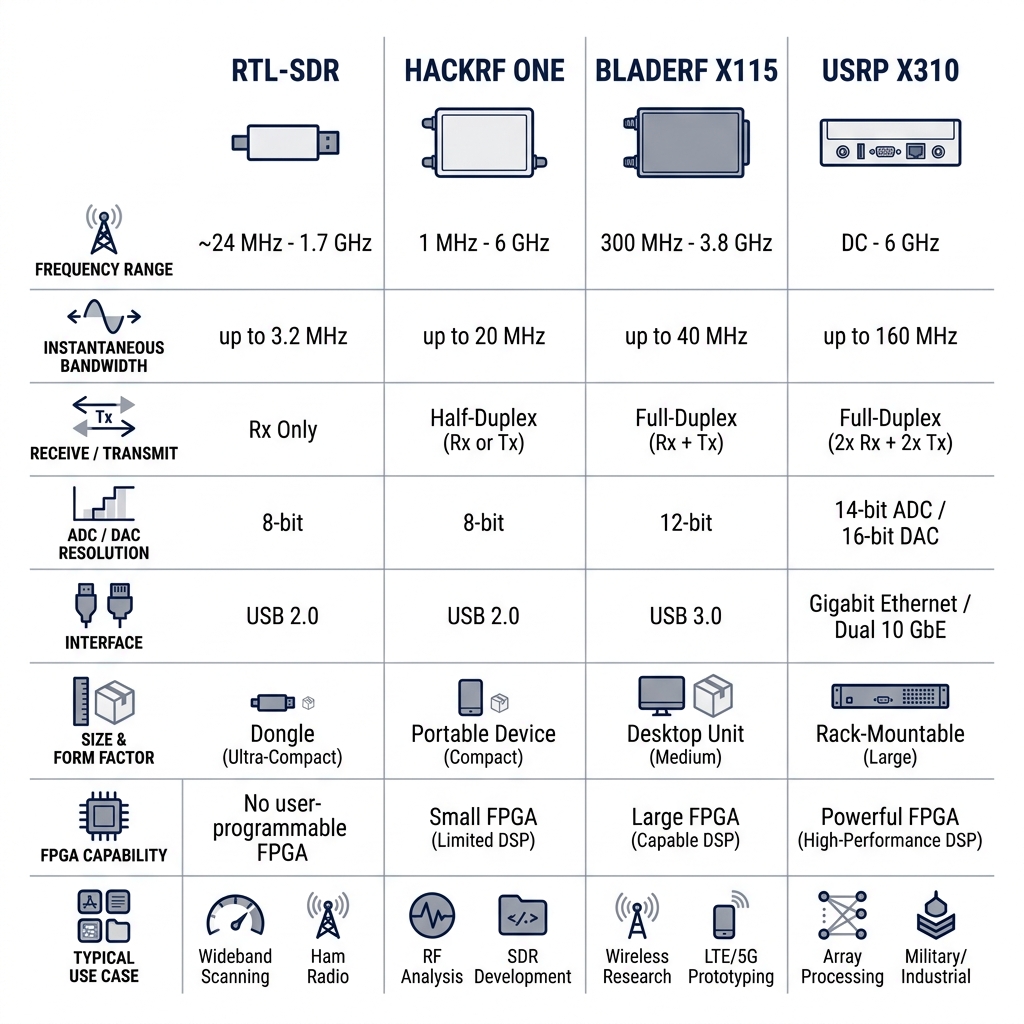 Figure 2. Comprehensive technical comparison across commercial SDR platforms from entry-level receivers to high-performance research transceivers.
Entry-Level Receivers (RTL-SDR v4)
Costing under $30, USB DVB-T dongles based on the Realtek RTL2832U controller and updated tuners (e.g. R828D) serve as accessible receive-only platforms. Operating from 500 kHz to 1.75 GHz with up to 2.4 MSps stable sampling rate, they are widely used for FM radio, ADS-B aircraft tracking, NOAA satellite reception, and amateur radio.
Mid-Range Transceivers (HackRF One & LimeSDR)
The HackRF One provides half-duplex transmit and receive capability across an expansive frequency range from 1 MHz to 6 GHz with up to 20 MHz bandwidth, ideal for broad spectrum exploration and security auditing. LimeSDR adds 2x2 MIMO full-duplex capability using LMS7002M transceivers.
Advanced Research Platforms (bladeRF & USRP X410/X310)
- Nuand bladeRF 2.0 micro / x115: Features full-duplex operation, high-speed 12-bit converters, Altera/Intel Cyclone FPGA, USB 3.0 SuperSpeed interface, SMB clock expansion for multi-unit phase synchronization, and expansion GPIOs for real-time physical layer research.
- Ettus USRP (e.g., USRP X310 / X410): High-end industrial-grade platform delivering up to 7.2 GHz frequency coverage, 400 MHz instantaneous bandwidth per channel, multiple 10/100 GigE fiber ports, and native multi-channel MIMO expansion for 5G NR and 6G ELAA testbeds.
4. Hardware Deep-Dive: Nuand bladeRF Platform
In our real-time physical-layer testbeds, we extensively utilize Nuand bladeRF SDR boards due to their high throughput, full-duplex operation, onboard FPGA reconfigurability, and SMB clock sharing for multi-SDR array processing.
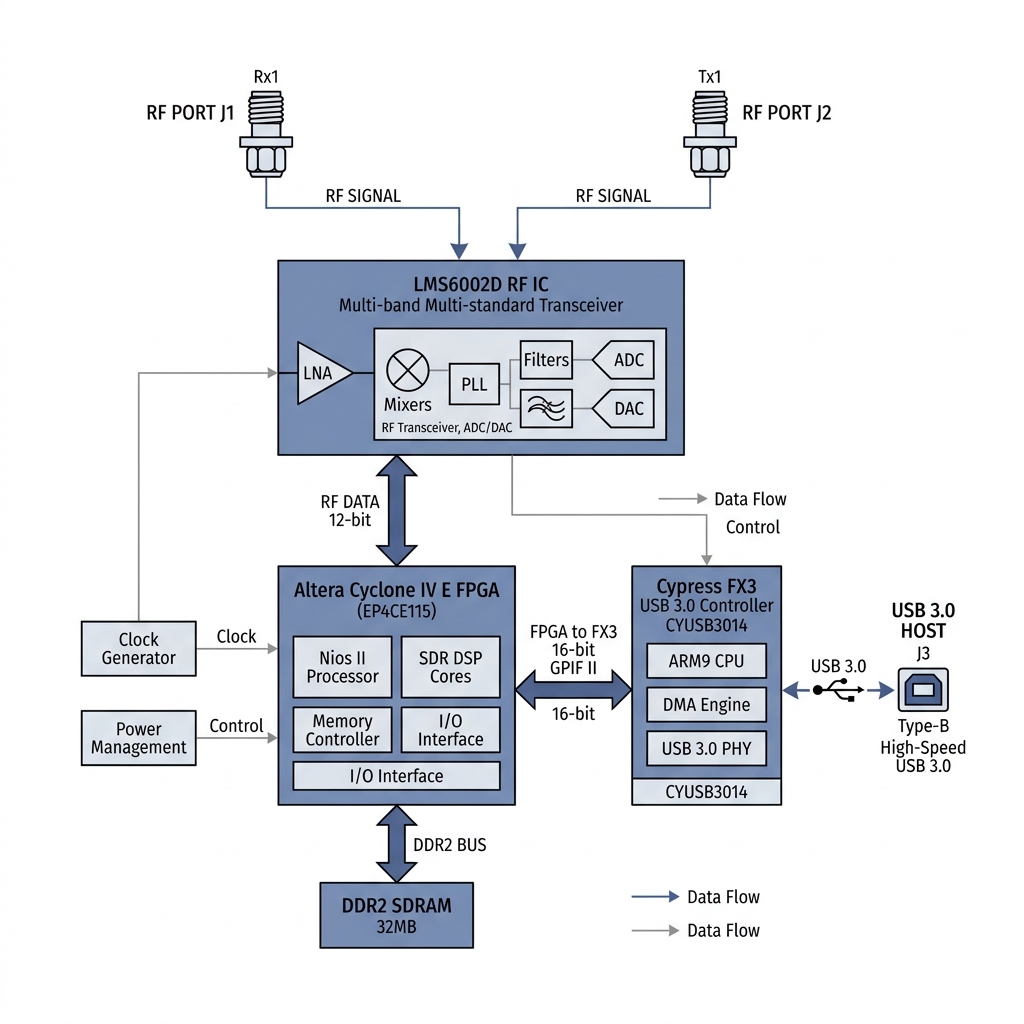 Figure 3. System block diagram and hardware architecture of the Nuand bladeRF SDR platform.
| Specification Parameter | Technical Value / Characteristic |
|---|---|
| Frequency Range | 47 MHz to 6 GHz (bladeRF 2.0 micro) / 300 MHz to 3.8 GHz (x115) |
| RF Transceiver IC | Analog Devices AD9361 / Lime Microsystems LMS6002D |
| Sampling Rate | Up to 61.44 MSps (Full Duplex) |
| ADC / DAC Resolution | 12-bit |
| Onboard FPGA | Intel Cyclone V / Cyclone IV (Up to 301k Logic Elements) |
| Host Interface | USB 3.0 SuperSpeed (Cypress FX3 Controller) |
| Synchronization | SMB Clock Input/Output & VCTCXO tuning for Multi-Device Array MIMO |
5. Future Horizons: 6G, Physical-Layer Network Coding & Cognitive Radio
Software-Defined Radio represents the cornerstone for next-generation wireless communications. When integrated with Software-Defined Antennas (SDA), dynamic spectrum sensing, and artificial intelligence, SDR evolves into Cognitive Radio (CR)—an intelligent system capable of autonomously sensing RF environments and optimizing physical-layer parameters in real time.
In our current research, SDR testbeds are deployed to prototype:
- Real-Time OFDM Transceivers (
gr-ofdm_testbed): Frame preamble synchronization, channel estimation, equalization, and payload streaming. - Multi-SDR Array Synchronization (
gr-DoA_BladeRF): Phase calibration and MUSIC Direction-of-Arrival (DoA) estimation across independent BladeRF units. - Physical-Layer Network Coding (
SDR_NC): Cognitive wireless networks and multi-robot multimedia relaying.
Read more about our hands-on hardware implementations in our project page: Software-Defined Radio (SDR) & GNU Radio Projects.
Enjoy Reading This Article?
Here are some more articles you might like to read next: